


How to Choose the Right Engine Oil for Your Car: The Complete 2026 Guide
Choosing the right engine oil for your vehicle depends primarily on your car’s owner’s manual, the oil viscosity grade, and the type of oil that best matches your driving conditions. The owner’s manual is the first and ultimate reference for determining the exact specifications your engine requires to protect it from wear and reduce fuel consumption.

Imagine that it is mid-July, you are driving your car on King Fahd Road in Riyadh, and the temperature outside the car is touching 48 degrees Celsius, while the engine temperature gauge slowly climbs toward the red zone. You stop at a traffic light and hear a light metallic sound from the engine that you have never heard before. You reach the nearest maintenance center, and the technician tells you a simple but costly sentence: "The oil inside does not suit Riyadh's weather, and the engine has suffered a bit because of it."
This scene is not imaginary; it repeats thousands of times every summer in Riyadh, Jeddah, Dammam, Al-Ahsa, and Hail, where many drivers are surprised to find that the oil they have used for years in another country, or that a friend recommended, does not actually suit the Kingdom's harsh climate or the nature of their daily driving.
Choosing the right engine oil is not just a number written on the oil container; it is an engineering decision that directly affects your car engine's lifespan, fuel consumption, and long-term maintenance costs. Unsuitable oil may mean early wear of internal engine parts, reduced performance, or even costly breakdowns that may reach replacing the entire engine in extreme cases.
In this comprehensive guide, we will take you step by step through everything you need to know about engine oil: from understanding viscosity grades such as 5w30 oil and 5w40 oil, to the difference between mineral and synthetic oils, how to read oil technical specifications, when the ideal time for an engine oil change is, and how to choose the most suitable oil for driving conditions in Saudi Arabia, whether you drive in the city or on long desert roads between cities.
Whether your car is Japanese, American, German, or Korean, and whether its engine runs on gasoline or diesel, you will find a clear and direct answer in this article, based on technical specifications approved by manufacturers, away from the filler and repeated information that fills the internet.



Why Is Engine Oil Considered the Most Important Fluid in Your Car?
If you ask any automotive engineer about the most important fluid that preserves the engine's life, the answer will always be: engine oil. The engine contains hundreds of moving metal parts that rub against each other thousands of times per minute, and without a proper oil layer separating them, direct metal-to-metal friction occurs, leading to rapid wear and permanent damage within just a few minutes.
The right oil does not only lubricate; it also participates in cooling the engine, cleaning it from impurities, preventing rust and corrosion, and maintaining combustion efficiency. For this reason, choosing the right engine oil is no less important than choosing the car itself.
What Actually Happens If You Use Unsuitable Oil?
- Increased internal friction, which raises the engine temperature abnormally.
- Accumulation of deposits and sludge inside the engine, especially with low-quality mineral oils.
- A decrease in fuel efficiency that may reach a noticeable rate depending on the engine type.
- Accelerated wear of the piston rings and cylinder liners.
- In extreme cases, prolonged use of the wrong oil may lead to complete engine damage requiring very expensive repair or full engine replacement.
Basic Functions of Engine Oil
What Are the Five Basic Functions of Engine Oil?
Engine oil performs five main functions: lubrication to reduce friction between metal parts, cooling by transferring part of the heat away from internal parts, cleaning by carrying impurities and deposits to the oil filter, preventing rust and corrosion by forming a protective layer on metal surfaces, and finally sealing between the piston and the cylinder wall to ensure ideal combustion pressure.
1. Lubrication
This is the most famous function, where the oil forms a thin layer between moving parts such as the crankshaft, pistons, and engine cams, preventing direct metal contact.
2. Cooling
The oil absorbs a large part of the heat generated by friction and combustion and transfers it away from sensitive parts, especially in areas not directly reached by the water cooling system.
3. Cleaning
Good oils contain detergent additives that prevent the formation of carbon deposits and sludge, and carry fine impurities to the oil filter to be trapped.
4. Anti-Corrosion Protection
The oil contains rust inhibitors that protect metal parts from moisture and combustion acids, which is especially important in coastal areas such as Jeddah, Dammam, and Khobar where humidity is high.
5. Sealing
The oil helps fill the tiny gaps between the piston and the cylinder wall, maintaining combustion pressure and preventing exhaust gases from leaking into the crankcase.
Types of Engine Oil: Mineral, Semi-Synthetic, Full Synthetic
What Is the Difference Between Mineral, Synthetic, and Semi-Synthetic Oil?
Mineral oil is extracted directly from crude oil refining with minimal chemical processing, while full synthetic oil is manufactured in the laboratory with uniform-sized molecules, providing higher performance and greater stability at high temperatures. Semi-synthetic oil is a mixture of the two types, offering a balance between price and performance, and is a popular choice in Saudi Arabia for owners of medium-aged cars.
| Type | Source | Performance at High Temperatures | Approximate Change Interval | Price |
|---|---|---|---|---|
| Mineral Oil | Direct crude oil refining | Relatively weak | Every 3,000 - 5,000 km | Low |
| Semi-Synthetic Oil | Mineral and synthetic mixture | Medium to good | Every 5,000 - 7,000 km | Medium |
| Full Synthetic Oil | Advanced chemical manufacturing | Excellent | Every 8,000 - 15,000 km depending on manufacturer recommendation | High |
When Is Each Type Recommended?
- Mineral oil: suitable for very old cars with simple engines, or short-term seasonal use, but less suitable for the harsh Saudi summer heat.
- Semi-synthetic oil: a good option for medium-aged cars and normal daily use inside cities such as Riyadh and Jeddah.
- Full synthetic oil: the ideal choice for most modern cars in Saudi Arabia, especially with turbo engines, intensive use, and long intercity travel, thanks to its high ability to withstand high temperatures and maintain viscosity for longer.
Understanding SAE Viscosity Grades: What Do 5W-30, 5W-40, and 0W-20 Mean?
What Does the Number Written on the Oil Container, Like 5W-30, Mean?
The first number followed by the letter W (Winter) refers to the oil's viscosity at low temperatures when starting the engine; the smaller the number, the more fluid the oil is in the cold and the faster it reaches engine parts. The second number refers to the oil's viscosity at normal engine operating temperature (approximately 100 degrees Celsius); the higher this number, the thicker the oil and the greater its ability to protect the engine at high temperatures.
Comparison Table of Common Viscosity Grades in Saudi Arabia
| Grade | Suitable for Cold Weather | Suitable for Saudi Summer Heat | Common Use |
|---|---|---|---|
| 0W-20 | Excellent | Very good (for modern engines designed for it) | Modern fuel-efficient Japanese cars |
| 5W-30 | Excellent | Very good | The most common option in Saudi Arabia for most cars |
| 5W-40 | Very good | Excellent | Diesel engines, turbo engines, severe use |
| 10W-40 | Good | Excellent | Older cars, high-mileage engines |
| 15W-40 | Medium | Excellent | Heavy diesel engines and trucks |
Is 5w30 Oil Better Than 5w40 Oil in Saudi Arabia?
There is no absolutely "better" oil; rather, there is an oil that is "more suitable" for your specific car engine. 5w30 oil suits the majority of modern cars originally designed for this viscosity and provides better fuel consumption. 5w40 oil, on the other hand, is thicker at operating temperature and is preferred for high-mileage engines, diesel engines, or cars subjected to continuous heavy loads such as towing or long desert driving. The golden rule is always to refer to the vehicle owner's manual issued by the manufacturer.
Expert advice: Do not rely on what your friend used in his car, because even the same model may need a different viscosity depending on the year of manufacture, engine size, and transmission type.
The Difference Between Gasoline Engine Oil and Diesel Engine Oil
Can Gasoline Engine Oil Be Used in a Diesel Engine?
This is not recommended at all. Diesel engine oil contains a higher concentration of anti-wear additives and resistance to acids produced by diesel fuel combustion, in addition to a higher ability to handle the large amounts of soot produced by a diesel engine compared to a gasoline engine. Using gasoline oil in a diesel engine may lead to rapid deposit accumulation and early wear of sensitive parts such as fuel injectors and the oil pump.
Main Differences Between the Two Types
- A diesel engine operates at much higher compression pressure than a gasoline engine, requiring oil that is more resistant to breakdown under pressure.
- Diesel oils often carry an API classification of the "C" category such as CK-4 or CJ-4, while gasoline oils carry an "S" category classification such as SP or SN.
- Some modern oils are designed to be "universal" and carry both classifications, but this must be verified on the container before purchase.
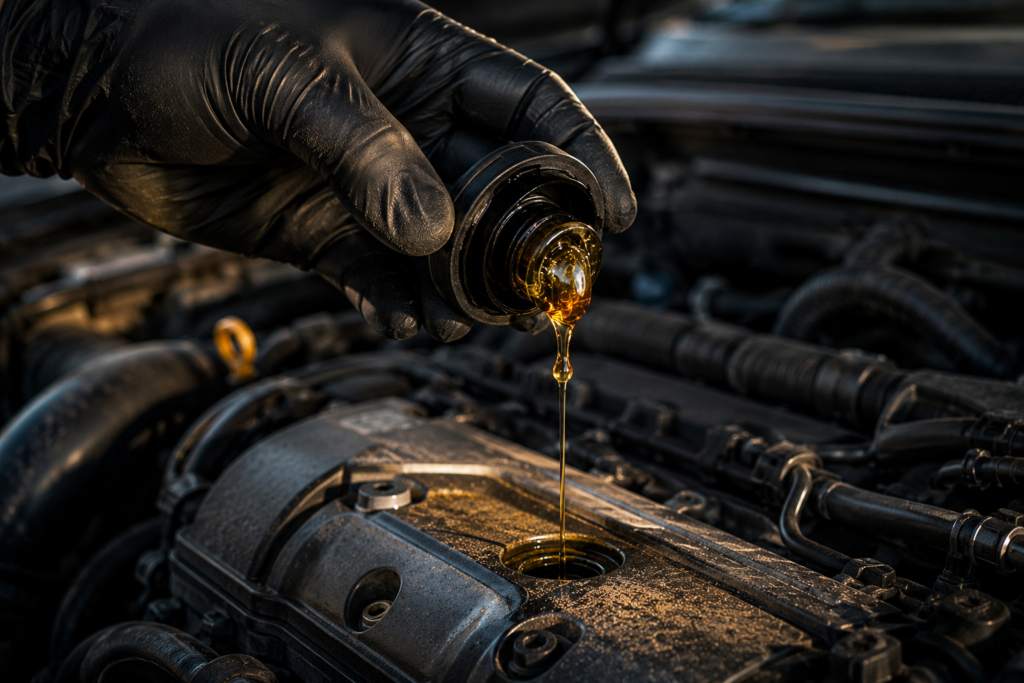
- Modern diesel engines equipped with diesel particulate filters (DPF) require Low SAPS oils to avoid clogging the filter.
How to Read the Engine Oil Container and API and ACEA Standards
What Do API and ACEA Classifications on the Oil Can Mean?
API (American Petroleum Institute) and ACEA (European Automobile Manufacturers' Association) are the two most famous bodies worldwide for approving engine oil specifications. The API classification usually appears as two letters such as SP or SN, where the second letter indicates the level of specification update (the further the letter is in the alphabet, the newer the specification). ACEA uses classifications such as A3/B4 or C3, and is often associated with stricter European emission standards.
Elements to Look for on the Oil Container
| Element | What Does It Mean? | Why Is It Important? |
|---|---|---|
| Viscosity grade (SAE) | Like 5W-30 | Must exactly match the manufacturer's recommendation |
| API classification | Like SP, SN Plus | Determines the level of protection and compatibility with modern engines |
| ACEA classification | Like C3, A3/B4 | Particularly important for European cars |
| Manufacturer approval | Like MB 229.5, VW 502.00, Dexos1 | Mandatory for some German and American cars to maintain the warranty |
| Production and expiry date | Printed on the container or bottom | Avoid buying old stored oil |
According to technical specifications issued by manufacturers, using an oil that does not carry the manufacturer's approval for your car model, even if the viscosity is correct, may affect warranty terms in some cases.
Choosing the Right Engine Oil for Saudi Arabia's Climate
Why Does Saudi Arabia's Climate Need Special Attention When Choosing Engine Oil?
The Kingdom of Saudi Arabia is characterized by a hot and dry desert climate most of the year, with temperatures that may exceed 50 degrees Celsius in areas such as Riyadh, Qassim, and Hail during the summer months, in addition to high humidity in coastal areas such as Jeddah, Dammam, Khobar, Yanbu, and Jazan. This harsh combination of heat, humidity, and dust imposes special requirements on engine oil that differ from countries with moderate climates.
Recommendations by Geographic Region
| Region | Main Climate Challenge | General Recommendation |
|---|---|---|
| Riyadh, Qassim, Hail | Extreme dry heat, large temperature differences | Full synthetic oil with viscosity that withstands high heat such as 5W-40 or according to manufacturer recommendation |
| Jeddah, Makkah, Taif | Heat with moderate to high humidity | Full synthetic oil resistant to oxidation and corrosion |
| Dammam, Khobar, Al-Ahsa | High humidity, coastal atmosphere | Oil containing strong rust inhibitors |
| Tabuk, Madinah, Yanbu | High summer heat with relative winter cold | Multi-grade oil that performs well in both cases such as 5W-30 |
| Abha, Jazan | Temperature variation between highlands and plains | High-quality multi-grade oil |
Should the Oil Change Interval Be Shortened in Saudi Arabia Compared to Other Countries?
Yes, in many cases. Driving in extreme heat, in long traffic jams as in the streets of Riyadh and Jeddah during peak hours, or continuous exposure to dust and sand, are all classified under "Severe Driving Conditions" as defined by manufacturers, which usually require shortening the oil change interval from the standard period recommended for moderate-climate countries.
The Best Engine Oil by Car Type
Japanese Cars (Toyota, Honda, Nissan, Mazda, Mitsubishi)
The majority of modern Japanese cars, especially Toyota and Nissan, are designed to work with low-viscosity oils such as 0W-20 or 5W-30 to achieve the best fuel efficiency. However, considering Saudi Arabia's heat, many specialized technicians recommend switching to a full synthetic oil with slightly higher viscosity such as 5W-30, even in models that originally come with 0W-20 oil, especially after the warranty period ends.
American Cars (Ford, Chevrolet, GMC)
Many American models, especially large V6 and V8 engines, rely on oils such as 5W-20 or 5W-30, and some require the Dexos1 approval specific to General Motors. Ford EcoBoost turbo engines need high-quality full synthetic oils due to high operating temperatures.
German Cars (Mercedes, BMW, Audi, Volkswagen)
German cars are among the most strict in oil requirements, often requiring special approvals such as MB 229.5 for Mercedes, VW 502.00/504.00 for Volkswagen and Audi, or BMW Longlife-01 for BMW. Using an oil that does not carry these approvals, even if its viscosity is correct, may not provide sufficient protection for these high-precision engines.
Korean Cars (Hyundai, Kia)
They usually work with 5W-30 or 5W-20 oils depending on engine size and year of manufacture, and approved full synthetic oils suitable for daily use in Saudi cities are available for them.
Quick Summary Table
| Brand | Common Viscosity | Important Note |
|---|---|---|
| Toyota / Lexus | 0W-20 / 5W-30 | Check the owner's manual for each model |
| Honda | 0W-20 / 5W-30 | Sensitive to oil quality with VTEC engines |
| Nissan | 5W-30 | Full synthetic oil preferred in summer |
| Ford | 5W-20 / 5W-30 | EcoBoost engines need high-quality oil |
| Chevrolet / GMC | 5W-30 (Dexos1) | Verify Dexos approval |
| Mercedes-Benz | 5W-30 / 5W-40 (MB 229.5) | Compliance with approval is mandatory |
| BMW | 5W-30 (BMW LL-01) | Compliance with approval is mandatory |
| Hyundai / Kia | 5W-20 / 5W-30 | Check the manual according to engine size |
When Should Engine Oil Be Changed?
What Is the Ideal Time to Change Engine Oil in Saudi Arabia?
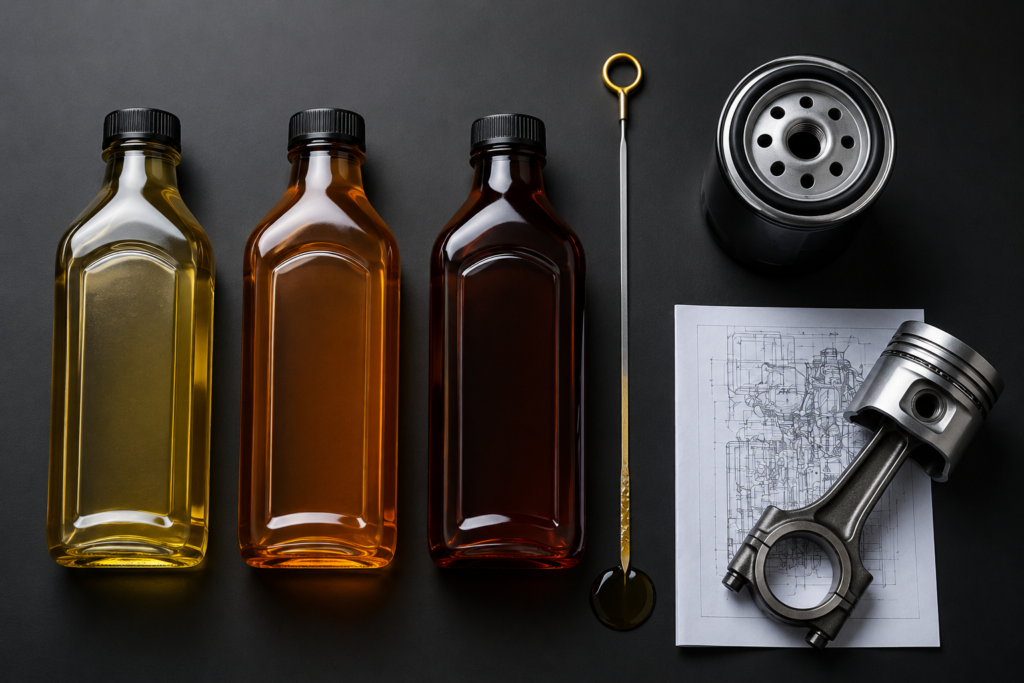
In general, and according to manufacturer recommendations adjusted for severe driving conditions, it is recommended to change full synthetic oil every 8,000 to 10,000 kilometers or every 6 months, whichever comes first, while semi-synthetic oil is recommended every 5,000 to 7,000 kilometers, and mineral oil every 3,000 to 5,000 kilometers. These periods are approximate and vary depending on the car model and engine type, and the most accurate reference is always the vehicle owner's manual.
Approximate Maintenance Schedule Table by Oil Type
| Oil Type | Change Interval in Normal Use | Change Interval in Severe Use (Heat, Congestion, Dust) |
|---|---|---|
| Mineral | 4,000 - 5,000 km | 3,000 km |
| Semi-synthetic | 6,000 - 7,000 km | 5,000 km |
| Full synthetic | 10,000 - 15,000 km | 7,000 - 8,000 km |
Factors Affecting the Actual Change Time
- Driving type: driving inside the city with continuous congestion tires the oil faster than driving on highways.
- Ambient temperature, especially in the summer months from June to September.
- Quality of fuel used.
- Engine age and overall mechanical condition.
- Presence of leaks or abnormal oil consumption.
Signs That Engine Oil Is Damaged or Needs Changing
How Do I Know That My Car's Engine Oil Needs Changing?
There are several clear signs indicating that the engine oil has actually expired and needs immediate changing, the most prominent of which are the oil color changing to dark black and losing its gloss, hearing light metallic knocking sounds from the engine when starting, the appearance of a burning smell from the AC vents, the oil warning light illuminating on the dashboard, and a noticeable increase in fuel consumption without a clear reason.
Detailed List of Warning Signs
- Change in oil color: new oil is transparent tending toward golden, and its turning to a dense dark black color indicates the accumulation of impurities.
- Low oil level on the dipstick: may indicate a leak or abnormal consumption.
- Metallic knocking sound (Knocking): especially when starting in the morning.
- Burning oil smell: indicates oil leaking onto hot engine parts.
- Unusual engine vibration at startup: especially in automatic cars.
- Oil light illuminating on the dashboard: a direct warning that must never be ignored.
- Blue smoke from the exhaust: a dangerous sign that often indicates oil burning inside the combustion chamber.
Important warning: continuing to drive with the oil pressure warning light on may lead to immediate and catastrophic engine damage within minutes. The car must be stopped immediately in a safe place when this warning is seen.
Oil Filter: Why Shouldn't It Be Neglected?
Should the Oil Filter Be Changed with Every Oil Change?
Yes, the oil filter must be changed with every engine oil change operation without exception. The oil filter is responsible for trapping fine metal impurities and carbon deposits that the oil collects while circulating in the engine, and if the old filter is left with new oil, it will transfer the impurities accumulated in it directly to the clean oil, nullifying the benefit of the oil change in the first place.
Common Types of Oil Filters
| Type | Description | Common Use |
|---|---|---|
| Regular paper filter (Spin-on) | Full metal filter with internal paper cartridge | Most Japanese and Korean cars |
| Cartridge filter | Paper cartridge only, replaced inside a fixed plastic housing | Common in German cars |
| High-efficiency filter | Higher filtration efficiency, designed for long intervals between changes | Used with long-life synthetic oils |
Combining the right engine oil with a high-quality original oil filter is the real equation for engine protection, and this is exactly what Kafarat Plus is keen on when providing the oil change service, where original filters compatible with each car model are used.
Synthetic vs Mineral Oil: Which Is Worth the Price Difference?
Is Synthetic Oil Worth the Price Difference Compared to Mineral Oil?
In most cases, yes. Although full synthetic oil is noticeably more expensive than mineral oil, its longer change interval (sometimes reaching two or three times the mineral oil period) means that the total cost over the year may be similar or even lower, with better engine protection, especially in Saudi Arabia's high heat.
Comprehensive Comparison
| Criterion | Mineral Oil | Full Synthetic Oil |
|---|---|---|
| High heat resistance | Weak to medium | Excellent |
| Cold weather performance | Medium | Excellent |
| Change interval | Short | Long |
| Cost per change | Low | High |
| Approximate annual cost | May be similar to synthetic due to frequent changes | Less frequent despite higher container price |
| Protection from sludge and deposits | Lower | Much higher |
| Suitability for turbo engines | Usually unsuitable | Very suitable |
Pros and Cons of Each Type
Mineral Oil
- Pros: low price, easily available.
- Cons: frequent changes, less protection in extreme heat, faster deposit accumulation.
Full Synthetic Oil
- Pros: superior protection, stable performance at extreme temperatures, longer change intervals, better engine cleaning.
- Cons: higher price per container.
Common Mistakes When Choosing or Changing Engine Oil
What Are the Most Common Mistakes Made by Car Owners in Saudi Arabia?
- Relying on non-specialized advice: choosing oil based on a friend's experience without consulting the vehicle owner's manual.
- Ignoring manufacturer approval: especially for German cars that require precise approvals such as MB or VW.
- Extending the change interval too much out of a desire to save cost, leading to greater damage later.
- Not changing the oil filter with every change operation.
- Mixing different types of oils (e.g., mineral with synthetic) without a clear technical reason.
- Ignoring regular oil level checks, especially before long intercity trips.
- Buying oil from unreliable sources that may be counterfeit or expired.
- Not considering severe driving conditions in Saudi Arabia when determining the change interval.
Important tip: always request an invoice and proof of the type of oil used at each change operation, as this helps you track your car's maintenance history and protects you when selling in the future or in any warranty-related dispute.
Engine Oil Change Cost in Saudi Arabia
Approximately How Much Does an Engine Oil Change Cost in Saudi Arabia?
The cost varies depending on the type of oil, engine size, and type of filter used. In general, mineral oil has the lowest cost, followed by semi-synthetic, while full synthetic oil has the highest price per operation but is the most economical in the long run due to its long usage period.
| Oil Type | Approximate Price Range per Operation (Including Filter) |
|---|---|
| Mineral oil | Low price tier |
| Semi-synthetic oil | Medium price tier |
| Full synthetic oil (international brands) | Relatively high price tier |
| Full synthetic oil with special specifications (German approval) | Highest price tier |
Exact prices vary continuously depending on the market, brand, and available offers, so it is always preferable to check updated prices directly through the Kafarat Plus platform, which provides transparent and clear pricing for each type of oil before confirming the booking, in addition to flexible payment options via Tabby and Tamara for those who wish to pay for periodic maintenance costs in installments.
Quick Buying Guide: How to Decide in Two Minutes?
Quick Steps to Choose the Right Engine Oil
- Open the vehicle owner's manual and look for the "Technical Specifications" or "Engine Oil Specification" section.
- Determine the recommended viscosity grade (such as 5W-30).
- Check for any required special approval (such as Dexos1, MB 229.5, or VW 502.00).
- Determine the type of oil suitable for your car's age and driving conditions (mineral, semi-synthetic, full synthetic).
- Consider Saudi driving conditions: heat, congestion, dust, long intercity travel.
- Choose an original oil filter compatible with the same change operation.
- Request the service from a trusted provider that offers original products and a warranty on the work performed.
Simplified Decision Tree
- Is your car modern (less than 5 years old) and used daily in the city? → Full synthetic oil with the manufacturer's recommended viscosity.
- Does your car exceed 150,000 km? → Full synthetic oil with slightly higher viscosity (such as switching from 5W-30 to 5W-40) after consulting a specialized technician.
- Do you drive intensively on desert roads or tow a trailer? → Full synthetic oil designed for severe use.
- Is your car a modern German one? → Strictly adhere to the manufacturer's approval without exception.
Why Choose Kafarat Plus for Engine Oil Services?
After all that we have reviewed, it is clear that choosing the right engine oil is not a simple decision, but requires precise knowledge of your car model, its technical specifications, and driving conditions in the Kingdom. This is exactly where Kafarat Plus comes in as a trusted partner in car maintenance.
The Kafarat Plus platform provides original engine oils from trusted international brands, with trained technicians able to determine the correct viscosity and approval for each car model, whether Japanese, American, German, or Korean. Kafarat Plus also provides an engine oil change service through mobile installation (Mobile Service) that reaches you at home or at work in various cities of the Kingdom, without the need to wait at traditional maintenance centers.
Among the most prominent features of the Kafarat Plus service in this field:
- 100% original products from approved international brands.
- Professional technicians who determine the appropriate type according to the actual vehicle manual, not guesswork.
- Transparent pricing without hidden fees.
- Flexible payment options via Tabby and Tamara to pay for maintenance costs in installments.
- Wide coverage including Riyadh, Jeddah, Dammam, Khobar, and other cities in the Kingdom.
- Easy booking via the website or app.
- Additional service for fleet owners through the Fleet Plus package dedicated to managing entire fleet maintenance.
This approach based on technical expertise first, and convenience and transparent pricing second, is what makes Kafarat Plus a trustworthy choice when it comes to any aspect of car maintenance in Saudi Arabia.
Conclusion
Choosing the right engine oil for your car is not a luxury or a secondary detail, but one of the most important decisions that determines your car engine's lifespan in the long run, especially under Saudi Arabia's harsh climate, which imposes additional challenges that do not apply to many other countries. From understanding viscosity grades such as 5w30 oil and 5w40 oil, to knowing the difference between gasoline engine oil and diesel engine oil, paying attention to manufacturer approvals, and determining the correct time for an engine oil change based on your actual driving conditions, all these elements come together to form a comprehensive protection equation for your car engine.
Precise technical expertise is the deciding factor between a correct decision that protects your investment in your car for years, and a random decision that may cost you thousands of riyals later in repairs that could have been completely avoided.
Start with the Right Step Today
If you are looking for an engine oil change service with original products and professional technicians who understand exactly what suits your car model, the Kafarat Plus team is ready to help you. Browse the collection of approved engine oils on KafaratPlus.com, or book the mobile installation service to reach you at home or at work with ease, and take advantage of flexible payment options via Tabby and Tamara. And if you manage a company car fleet, learn about the Fleet Plus package dedicated to managing entire fleet maintenance from one place. Your car deserves the right care, and Kafarat Plus is here to provide it to you with confidence and transparency.
🎥 Watch: How to Read Tire Size? - Kafarat Plus Tips
To learn more about how to read and understand tire size correctly, watch this educational video from Kafarat Plus. The video explains in a simplified way how to read the numbers and symbols written on the tire and what each of them means, helping you choose the right size for your car with ease.
An educational video from Kafarat Plus showing how to read tire size and understand the symbols and numbers written on it to choose the right tire for your car.
Frequently Asked Questions - Engine Oil
What is the best oil for turbo engines?
Turbo engines need full synthetic oil with high resistance to heat and oxidation, because the turbo operates at much higher temperatures than normal engines. Oils with viscosity such as 5W-30 or 5W-40 are usually preferred according to the manufacturer's recommendation, while ensuring that the oil carries a modern API classification such as SP, which provides additional protection against the Low Speed Pre-Ignition (LSPI) phenomenon common in modern turbo engines.
Can I mix synthetic oil with mineral oil?
Chemically, most modern oils are technically mixable only in emergencies, but this is not recommended as a permanent practice because it reduces the superior properties of synthetic oil and lowers the overall protection level closer to mineral oil. It is always best to stick to one fixed type and transition gradually through a complete oil change rather than mixing.
How often should the engine oil level be checked?
It is recommended to check the engine oil level using the dipstick at least once a month, and before any long intercity trip, especially in summer when the oil consumption rate increases due to high heat. The check is done with the car on level ground and after stopping the engine for a few minutes to get an accurate reading.
Does early oil change harm the engine?
Changing the oil before the recommended time does not harm the engine at all, and may even be beneficial in cases of severe driving or dusty weather, but it means an unnecessary additional cost if done too frequently without a clear technical reason.
What is the difference between 0W-20 oil and 5W-30 oil?
The main difference is in viscosity at cold start, where 0W-20 oil is more fluid and reaches engine parts faster at startup, while 5W-30 is slightly thicker at normal operating temperature, giving it better protection at high heat. The grade specifically recommended by the manufacturer must be used without discretionary change.
Should engine oil be changed by distance or by time?
Whichever comes first between the distance driven and the time specified by the manufacturer must be adopted. Even if your car has not covered the recommended distance, the oil oxidizes and gradually loses its properties over time due to exposure to heat and moisture inside the engine, so most manufacturers specify a maximum time period (such as 6 months or one year) alongside the distance limit.
Is adding more engine oil than the required limit harmful?
Yes, increasing the oil level above the maximum limit specified by the dipstick may lead to increased pressure inside the crankcase and the entry of air foam into the oil, reducing lubrication efficiency, and may cause leaks from engine gaskets due to excess pressure.
Is low engine oil dangerous?
Yes, very dangerous. Low oil means an insufficient lubrication layer between moving parts, leading to direct metal friction and a sharp rise in temperature, and may cause immediate and catastrophic engine damage within a few minutes of continuous driving with severely low oil.
How do I know exactly the type of oil suitable for my car?
The most accurate source is the vehicle owner's manual, which specifies exactly the viscosity grade and any special approvals required. Alternatively, you can consult a specialized technician or a trusted maintenance center such as Kafarat Plus, which has an updated database of specifications for all common models in the Saudi market.
Does the suitable engine oil differ between new cars and old cars?
Yes, new cars are often designed for low-viscosity oils to improve fuel efficiency, while older high-mileage cars often need slightly thicker oils to compensate for natural wear in internal engine parts and reduce the probability of minor leaks.
What are the signs of using unsuitable oil for a car engine?
Among the most prominent signs: abnormal rise in engine temperature, increased fuel consumption, hearing light metallic knocking sounds, and the appearance of abnormally colored smoke from the exhaust. If you notice any of these signs after a recent oil change, it is recommended to consult a specialized technician to verify that the oil used matches the engine specifications.
Can any full synthetic oil be used regardless of the brand?
No, although all full synthetic oils share good general properties, some cars, especially German ones, require precise approvals from the manufacturer itself (such as MB, VW, or BMW Longlife), and it is not enough for the oil to be "full synthetic" without carrying this specific approval.
Does an oil change include checking other parts of the car?
At professional service providers such as Kafarat Plus, the oil change process usually includes a quick visual inspection of other fluid levels such as coolant and brake fluid, in addition to checking the condition of the air filter, giving you a more comprehensive picture of your car's overall condition without additional cost.
What is the best time of day to change engine oil in summer?
It is preferable to change the oil in the early morning hours or after the car has cooled down for a sufficient period, to avoid potential burns when handling hot oil, and to ensure a more accurate reading of the oil level after the change when all fluids have settled.
Do electric and hybrid cars need an engine oil change?
Fully electric cars do not contain an internal combustion engine and therefore do not need engine oil at all, while hybrid cars still contain a traditional gasoline engine that needs oil change according to the recommended schedule, although change intervals are sometimes longer due to the lower actual engine operating hours compared to traditional cars.
Is the smell of burning oil from the AC vents dangerous?
Yes, and it requires immediate inspection, as it often indicates an oil leak that has reached a hot part of the engine such as the exhaust manifold, and may also indicate abnormal oil consumption due to internal engine wear requiring quick professional diagnosis.
Does the suitable engine oil differ between city driving and long-road driving?
Yes, in terms of the change interval; driving inside the city with continuous congestion and repeated stopping and starting is classified as severe driving conditions requiring a shortened change interval, while steady driving on intercity highways is relatively less stressful on the oil, with the necessity of considering high temperatures on long desert roads.
How do I make sure the oil used at the maintenance center is original?
It is recommended to request to see the oil container before use and verify the integrity of the seal and production date, and to deal only with trusted service providers that provide clear invoices specifying the type and brand of oil used, such as Kafarat Plus, which guarantees 100% original products for every oil change operation.
Does a higher engine oil price necessarily mean better quality?
Not always absolutely, but there is often a relationship between price and quality when comparing oils from approved international brands. More important than price alone is ensuring that the oil matches your car's specifications, viscosity, and approval, because an expensive oil that does not match your engine's specifications will not provide the required protection.
Can an engine oil change service be booked at home or at work?
Yes, Kafarat Plus provides a mobile oil change service that reaches you directly at home or at work in various cities of the Kingdom, saving you the waiting time at traditional maintenance centers, while maintaining the same quality standards and original products.
What is the best oil specification for those who frequently tow a trailer or caravan in Saudi Arabia?
For driving under continuous heavy load such as towing a trailer or caravan, it is recommended to use a full synthetic oil with slightly higher viscosity within the range recommended by the manufacturer, with a shortened change interval from the usual due to increased operating temperature and mechanical load on the engine in these specific conditions.