

Artificial Intelligence in Saudi Automotive Service Centers: How It Changed the Rules of the Game Forever
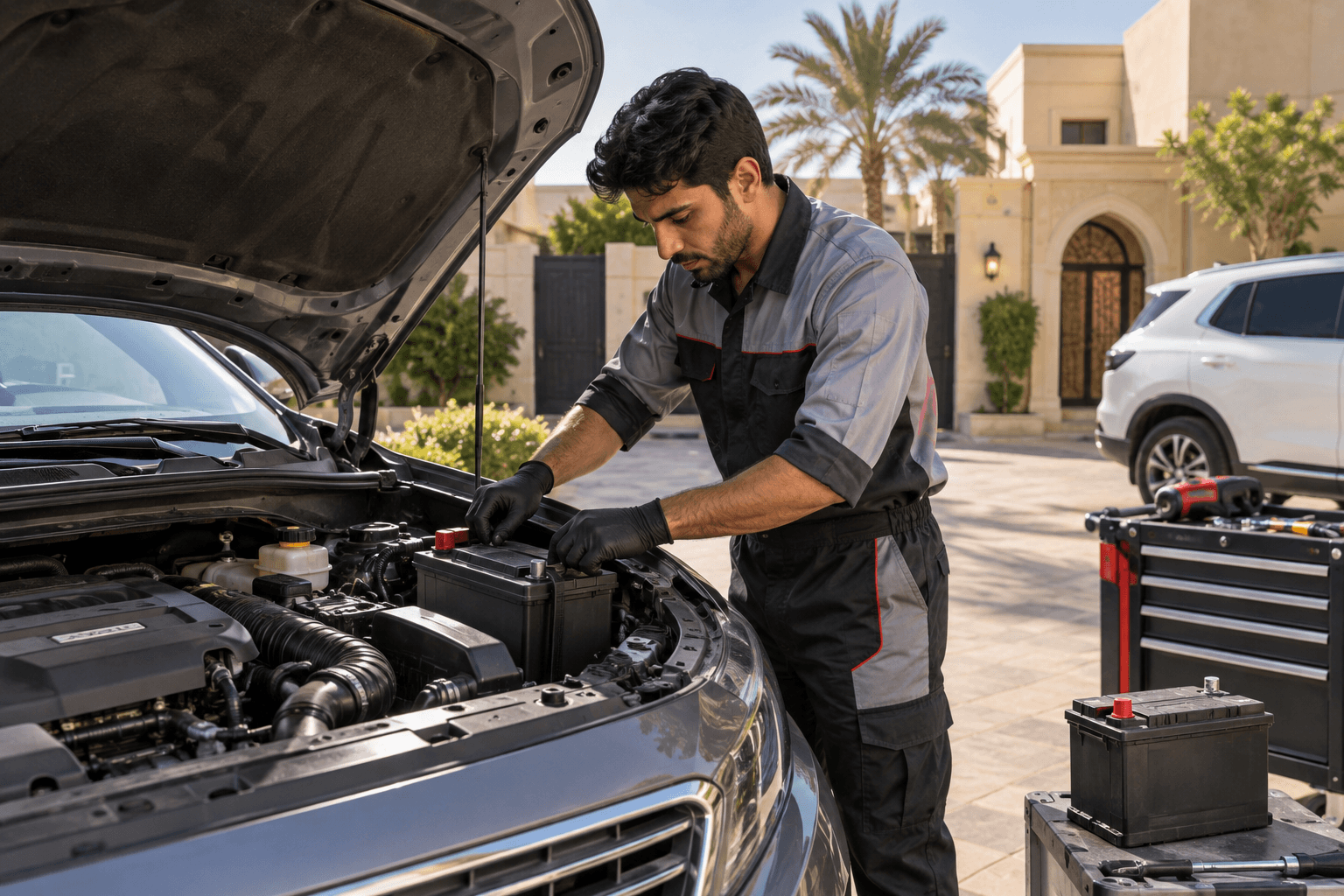
Automotive service centers across the Kingdom of Saudi Arabia have undergone a major transformation driven by Saudi Vision 2030. Traditional workshops have moved away from relying solely on visual inspections and guesswork, replacing them with artificial intelligence systems that have redefined the concept of customer service in the automotive industry.

Imagine you are on your way from Riyadh to Qassim on an important business trip, and suddenly the dashboard lights up with a warning light whose exact meaning you don't know. Your heart beats fast, and the minutes pass heavily, while you don't know if it's something simple like low tire pressure, or something dangerous like a problem with the braking system. This situation is familiar to almost every Saudi driver, especially given the nature of long distances between cities, and the harsh summer temperatures that put additional burdens on the engine, battery, and tires.
A few years ago, the only solution was to stop at the nearest workshop and wait for a technician to manually inspect the car, relying on their experience and intuition, and sometimes on trial and error. Today, however, Car AI (Artificial Intelligence in cars) has entered as an active player that radically changes this equation. Diagnostic devices equipped with machine learning algorithms have become capable of reading thousands of data points from the car's sensors in mere seconds, pinpointing the cause of the problem with an accuracy that sometimes surpasses that of a traditional technician, and even predicting faults that haven't occurred yet.
This shift is not just a "tech trend," but a real response to an urgent need: reducing downtime, lowering unnecessary repair costs, and raising the safety level on Saudi roads, which witness heavy traffic around the clock. In this comprehensive guide, we will take you on an in-depth journey into the world of Car AI as it is actually applied in car maintenance centers in Saudi Arabia, and how leading companies like Kafarat Plus deal with these technologies to provide a faster, more accurate, and transparent maintenance experience for their customers in Riyadh, Jeddah, Dammam, and the rest of the Kingdom's regions.
Whether you are a car owner looking for a deeper understanding of what happens under the hood, a fleet manager seeking to reduce operating costs, or a tech enthusiast interested in the future of the automotive industry, this article will answer all your questions in a practical and clear manner, away from exaggerated technical complexity.


What is Car AI? (Artificial Intelligence in Car Maintenance)
Simplified Definition
Car AI is the use of machine learning algorithms and big data analytics to understand the behavior of various car components, and detect abnormal patterns that may indicate a current or imminent fault. Instead of relying solely on the technician's experience and visual observation, smart systems collect data from dozens of sensors spread throughout the car (engine, transmission, brakes, battery, tires) and analyze it in real-time or near real-time.
In other words: Artificial Intelligence does not "invent" magic solutions, but rather works as an additional analytical layer on top of the data already present in the car's Electronic Control Unit (ECU), transforming it into information that is understandable and actionable quickly.
Why has Car AI become important in Saudi Arabia specifically?
The Kingdom of Saudi Arabia has climatic and geographical characteristics that make the application of these technologies doubly valuable:
- Very high summer temperatures in cities like Riyadh, Dammam, and Al-Ahsa put extra pressure on the battery, oils, and cooling systems.
- Long distances between cities (such as Riyadh–Jeddah, or Tabuk–Hail) make early fault detection a matter of safety, not a luxury.
- Sand and dust frequently affect air filters and suspension systems.
- The growth of the commercial and logistics fleet sector thanks to Vision 2030 makes predictive maintenance an economic priority for every transport or delivery company.
This combination of factors makes it natural for car maintenance centers in the Kingdom to move towards adopting smart solutions that reduce surprises and increase transparency with the customer.
Diagnostic time comparison: Traditional inspection vs. Artificial Intelligence — Approximate time in minutes to diagnose the problem according to the case type.
How does Car AI work in diagnosing faults in Saudi Arabia?
What is the best simplified explanation for how Car AI works in diagnosing faults in Saudi Arabia? Smart systems work through three basic steps: first, collecting data from the OBD-II port and various car sensors; second, comparing this data with digital models trained on thousands of similar cases to identify abnormal patterns; and third, providing a simplified report to the technician explaining the probable cause of the fault and its urgency level. This process takes just a few minutes compared to hours of traditional manual inspection.
Diagnostic Stages in Detail
Stage One: Data Acquisition
An advanced diagnostic device is connected to the OBD-II port, usually located below the steering wheel. This device reads Diagnostic Trouble Codes (DTC) as well as live data such as engine temperature, RPM, oxygen ratio in the exhaust, and oil pressure.
Stage Two: Algorithmic Analysis
Here the fundamental difference appears. Instead of the device displaying a single error code that the technician needs to interpret manually, the machine learning algorithm links this code with the rest of the live readings, and compares it with a massive database of similar cases, to determine the root cause and not just the apparent symptom.
Stage Three: Reporting and Recommendation
The technician (and sometimes the customer themselves via an app) receives a clear report that includes: a description of the problem in simple language, the severity level (urgent / moderate / can be postponed), the parts likely to be affected, and sometimes an approximate cost estimate.
A Practical Example from Saudi Reality
Let's assume a driver in Jeddah notices a slight vibration in the steering wheel at certain speeds. In a traditional inspection, the technician might start by checking the tire balance, then the suspension system, then the wheel alignment angles, through trial and error. But with a smart diagnostic system, the device links data from speed sensors, wheel vibration, and previously recorded tire maintenance history, to directly suggest that the most likely cause is an imbalance in one of the front tires, saving valuable time for both the technician and the customer.
Traditional Diagnosis vs. Smart Diagnosis: A Comprehensive Comparison
| Criterion | Traditional Diagnosis | AI Diagnosis |
|---|---|---|
| Time required for initial inspection | From 30 minutes to several hours | Usually from 5 to 15 minutes |
| Accuracy in identifying the root cause | Depends on the individual technician's experience | Relies on extensive data analysis and recurring patterns |
| Ability to predict future faults | Very limited | Available through predictive maintenance |
| Transparency with the customer | Verbal or brief written report | Detailed shareable digital report |
| Reliance on the human element | Very high | Medium (the technician is still necessary to make the final decision) |
| Initial cost for the workshop | Relatively low | Initial investment in hardware and software |
| Suitability for complex and intertwined faults | A major challenge | More effective thanks to multiple data analysis |
Does this mean the human technician is no longer needed?
Not at all, and this is an important point that must be clarified frankly. According to recommendations from diagnostic system manufacturers, the role of the expert technician remains essential in making the final decision, field-verifying recommendations, and dealing with exceptional cases that databases do not fully cover. Artificial intelligence here is an enabling tool for the technician, not a replacement for them — just as a doctor does not dispense with a CT scan, but remains the one who makes the final medical decision.
Comprehensive performance comparison: Traditional diagnosis vs. Smart diagnosis — Relative evaluation across five main criteria (out of 100).
Prominent Car AI Technologies Used in Car Maintenance Centers
Smart OBD-II Systems Powered by Machine Learning
These devices have evolved significantly from traditional code readers. They have become capable of learning the vehicle's specific driving patterns, and distinguishing the differences between a real fault and a transient reading resulting from a temporary condition such as extreme summer weather in Najran or Jazan.
Internet of Things (IoT) Sensors
Additional sensors are installed in some modern vehicles and company fleets to continuously monitor engine vibration, tire temperature, and battery status, and wirelessly send data to a centralized analytics platform.
Predictive Machine Learning
This technology specifically is the most valuable for fleet owners. Instead of waiting for a fault to occur, historical data trends (such as the gradual deterioration of battery performance) are analyzed to predict when replacement will be needed before the vehicle suddenly breaks down on a highway between Dammam and Khobar.
Smart Mobile Apps for Remote Diagnosis
Some modern maintenance centers in Saudi Arabia provide apps that allow the customer to view their car's status report, follow the recommended maintenance schedule, and book an appointment or request a mobile service directly from their phone.
Computer Vision for Tire and Brake Inspection
An emerging technology that relies on analyzing high-resolution images of the tire surface or brake disc to determine the wear rate and severity level with an accuracy that surpasses mere visual inspection, especially in identifying uneven wear resulting from wheel alignment issues.
Predictive Maintenance: The Future of Fleet Management in Saudi Arabia
What is AI Predictive Maintenance?
Predictive maintenance is an approach that relies on analyzing the historical and current performance data of the vehicle to predict the time of a potential fault before it actually occurs, instead of waiting for the fault to appear or relying solely on fixed time-based maintenance schedules. This approach significantly reduces unexpected vehicle downtime and saves emergency repair costs.
Why is it vital for commercial fleet management?
Any company managing a fleet of dozens or hundreds of vehicles — whether a delivery company, freight transport, or logistics services — knows that the sudden downtime of a single vehicle means direct losses: delivery delays, towing costs, and perhaps a more complex repair that could have been avoided if the problem had been discovered early.
This is where solutions like Fleet Plus for fleet management from Kafarat Plus come in, combining traditional fleet management (maintenance schedules, consumption tracking, tire and battery management) with the principles of smart maintenance, to help fleet managers make proactive decisions instead of late reactions.
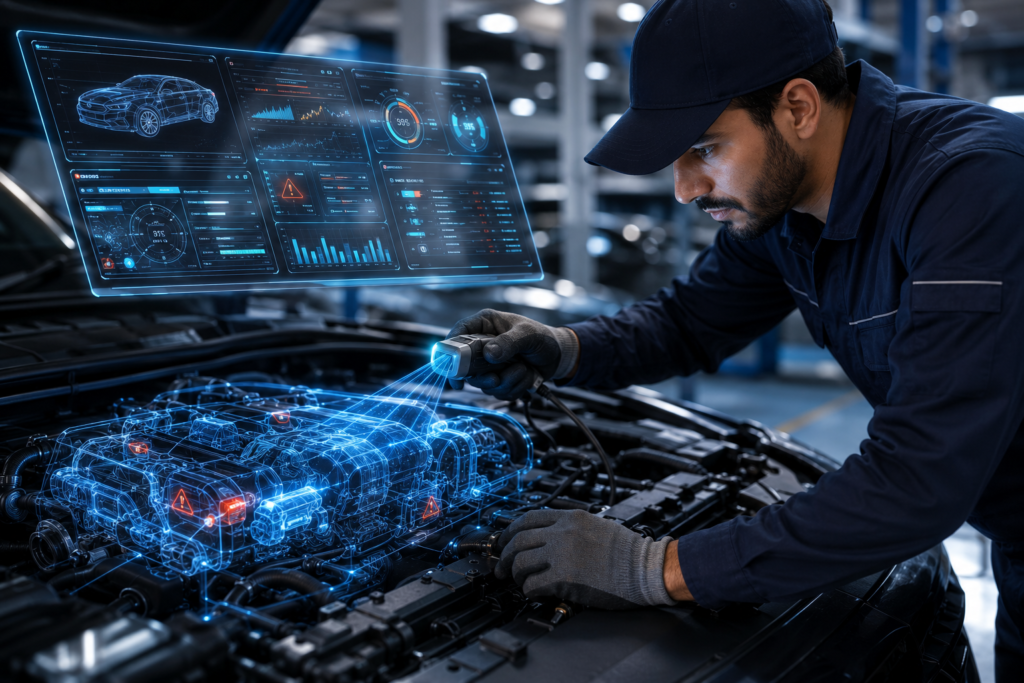
Table: Comparison between Traditional Routine Maintenance and Smart Predictive Maintenance
| Aspect | Traditional Routine Maintenance | Smart Predictive Maintenance |
|---|---|---|
| Decision Basis | Fixed time schedule (every 5,000 or 10,000 km) | Actual component condition based on data |
| Probability of sudden downtime | Relatively high | Noticeably low |
| Parts usage efficiency | Parts that are still functional might be replaced | Replacing the part only when actually needed |
| Long-term cost | Medium to high | Lower thanks to reducing emergency repairs |
| Suitability for large fleets | Acceptable | Ideal and highly recommended |
Advantages of Car AI in Car Maintenance Centers
Tangible Time Savings
Reducing diagnostic time from hours to minutes means the driver gets back on the road faster, which is especially important for those covering long distances between cities like Riyadh and Abha, or Medina and Tabuk.
Higher Accuracy in Identifying the Root Cause
Instead of replacing parts through trial and error, smart analysis helps identify the real cause of the fault from the first time, reducing repeated workshop visits for the same problem.
Greater Transparency with the Customer
Detailed digital reports give the car owner a clear understanding of what is happening, instead of relying entirely on a verbal explanation that might be difficult to verify.
Reducing Unnecessary Costs
When the diagnosis is accurate, the likelihood of replacing healthy parts or performing unnecessary repairs decreases, which directly reflects on the customer's wallet. You can, for example, review the car batteries products page to compare prices before making a replacement decision.
Supporting Preventive Maintenance Decisions
Instead of waiting for a fault to appear, smart systems help plan proactive maintenance, especially for the battery, tires, and engine oil, which are the elements most affected by Saudi Arabia's hot climate.
Road safety improvement indicator thanks to early diagnosis — An estimated percentage of the decrease in the probability of sudden breakdown when adopting smart maintenance.
Challenges and Limitations of Implementing Car AI in Saudi Workshops
Professional honesty dictates not presenting an ideal picture without reservations. There are real challenges facing the spread of these technologies:
High Initial Investment
The cost of advanced diagnostic devices and their associated software is not cheap, which makes some small workshops delay fully adopting these solutions.
The Need to Train Technical Staff
A smart device without a technician trained to interpret its outputs and apply actual maintenance remains an incompletely useful tool. Investing in technician training is no less important than investing in the devices themselves.
Data Limitations for Some Older Models
Older vehicles or those not equipped with enough sensors may not benefit from these technologies to the same extent as modern, sensor-rich models.
Over-reliance and the Risk of Overlooking Manual Inspection
Some simple mechanical problems (such as an unusual sound or a burning smell) are still best detected through direct human sense and experience, and artificial intelligence cannot fully replace this sensory observation yet.
How Does AI Reduce Repair Costs and Downtime?
Does AI really save on maintenance costs?
Yes, primarily indirectly. AI does not make spare parts cheaper, but it reduces unnecessary repairs, and detects faults in their early stages before they worsen and turn into costly repairs. It also reduces the car's downtime, which is a crucial factor especially for commercial fleet owners who lose money with every day of downtime.
Illustrative Calculation Example
Let's take a simple example: a car battery that starts losing its efficiency gradually without the driver noticing any clear symptoms. In the traditional scenario, the battery often breaks down suddenly, requiring an emergency service and perhaps towing the vehicle, at a total cost much higher than the price of a new battery alone. But with a smart monitoring system that detects gradual deterioration, the driver can replace the battery at a convenient time, via a service like home battery replacement from Kafarat Plus, without any sudden downtime or extra emergency costs.
Does Car AI Improve Car Safety and Reliability?
The short answer: yes, directly and tangibly. Early detection of brake problems, low tire pressure, or weak battery significantly reduces the likelihood of a sudden breakdown while driving on highways, which is one of the most common causes of traffic accidents related to the mechanical condition of the vehicle in Saudi Arabia. According to the Transport General Authority (TGA), the vehicle's technical readiness is among the factors that directly affect road safety indicators on Saudi roads.
Key Safety Points Related to Smart Diagnosis
- Detecting uneven tire wear before it causes a sudden blowout, especially on hot desert roads.
- Monitoring weak brake performance before the problem worsens into a complete failure to stop safely — learn about the signs of brake damage and when to replace them.
- Monitoring battery health to avoid sudden breakdowns in remote areas between cities.
- Early warnings about engine overheating, a common problem in the hot Saudi summer.
Smart Car Maintenance Centers in Saudi Arabia: Where to Find Them?
The Saudi market is witnessing a gradual expansion in adopting smart diagnostic solutions, especially in major cities like Riyadh, Jeddah, and Dammam, where a stronger digital infrastructure exists and customer demand for transparency and speed is higher. Signs that a maintenance center actually relies on smart technologies include:
- Providing a detailed digital diagnostic report instead of just brief verbal notes.
- The ability to book the service and track its status via a mobile app.
- Providing mobile maintenance and home installation services, which often rely on smart scheduling and tracking systems.
- Transparency in quoting prices before starting work, based on an accurate diagnosis and not a rough estimate.
How is Kafarat Plus Adopting this Trend?
Kafarat Plus operates within this general trend of smart maintenance industry in Saudi Arabia, by facilitating access to essential installation and maintenance services (tires, batteries, oils, brakes) through a digital platform that allows the customer to know the price in advance, book a home or center service appointment, and track the order with complete transparency from start to finish. This approach based on data and digital transparency is the core of what modern smart maintenance represents, even before talking about the advanced diagnostic algorithms themselves.
Priority of AI implementation by service type — Priority level for the Saudi driver according to the sub-sector.
The Role of Kafarat Plus in Adopting Car AI
Kafarat Plus's Philosophy Towards Technology
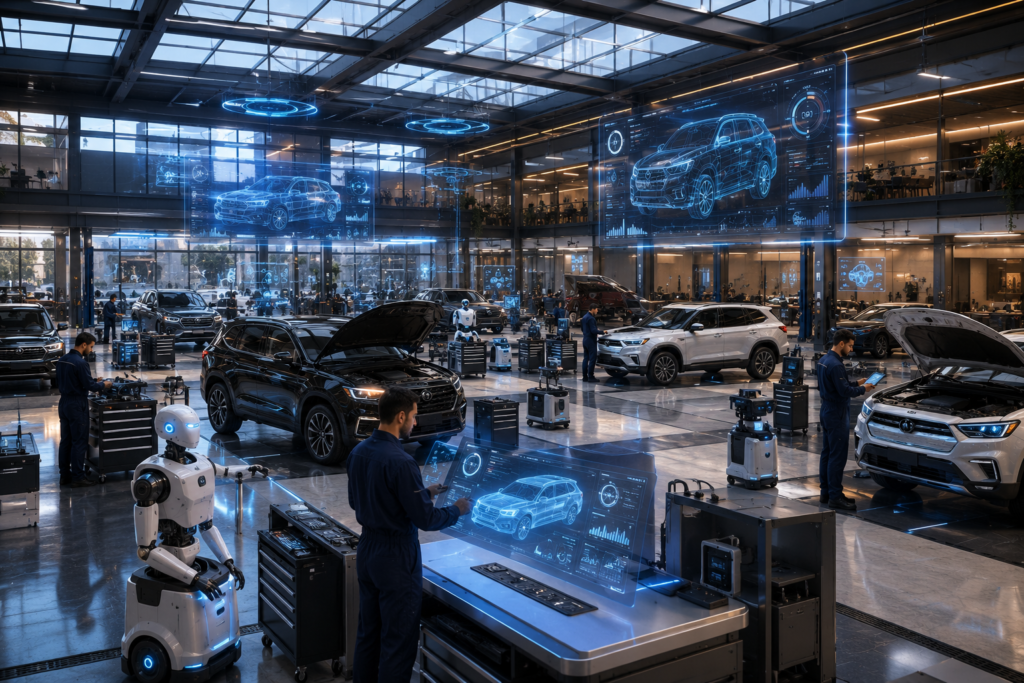
The core idea adopted by Kafarat Plus is not "replacing the technician with a machine," but rather empowering both the technician and the customer through more accurate and transparent digital tools, which reflects the philosophy of modern Car AI based on supporting decisions rather than replacing humans. This appears in several aspects of the service:
- Pricing Transparency: Instead of waiting for the customer to arrive at the workshop to know the final price, the digital platform allows knowing the approximate prices of products and services in advance, a principle that perfectly aligns with the "diagnosis before commitment" philosophy provided by AI.
- Mobile Installation Service: One of the most prominent services of Kafarat Plus is the home and office installation service for tires and batteries, a service that relies heavily on smart technical scheduling and tracking systems to ensure the technician arrives on time with the correct part.
- Flexible Financing: Kafarat Plus provides installment payment options via Tabby and Tamara, making it easier for the customer to make a preventive or proactive maintenance decision without an immediate financial barrier, which aligns with the philosophy of predictive maintenance that encourages early action instead of waiting for a breakdown.
- Fleet Plus for Fleet Management: For business owners and fleet managers, Kafarat Plus offers the Fleet Plus solution designed to facilitate tracking the status of multiple vehicles and efficiently scheduling their maintenance, reducing unplanned downtime and improving daily operational efficiency.
Why Does This Matter to a Customer Looking for a Reliable Maintenance Center?
Ultimately, what most car owners in Saudi Arabia are looking for are three simple things: speed, transparency, and trust in the quality of the part used. Whether the facility uses the latest AI algorithms or advanced traditional diagnostic tools, the real standard for the customer is: Did I get the correct diagnosis the first time? Was the price clear? Did the technician stick to the appointment? These are the standards that build long-term trust, and this is what Kafarat Plus strives to provide with every installation or maintenance operation.
Practical Guide: How to Choose a Maintenance Center that Relies on Smart Technologies?
Checklist Before Choosing the Center
- Does the center provide a written or digital diagnostic report and not just a verbal one?
- Does it clarify the approximate price before starting the actual work?
- Does it provide an electronic booking service or a mobile app to track the order?
- Does it use spare parts, oils, and tires from well-known and reliable brands, compliant with the specifications of the Saudi Standards, Metrology and Quality Organization (SASO)?
- Does it provide a clear warranty on the replaced parts and the work done?
- Does it provide a home or office installation option if needed?
- Does it provide flexible payment options such as interest-free installments?
Simplified Decision Tree: Do I Need a Smart Maintenance Center or is a Traditional One Enough?
- If your car is relatively new (less than 7 years old) and equipped with advanced electronic sensors ← A center that uses advanced digital diagnosis is preferred to ensure accurate reading of all codes and data.
- If you manage more than 5 vehicles (small or medium fleet) ← The ultimate preference is for a smart fleet management solution like Fleet Plus, to reduce unplanned downtime and organize routine maintenance.
- If your problem is simple and clear (such as a routine oil change or replacing a damaged tire) ← A reliable center that offers transparency in price and quality is sufficient, without the necessary need for complex diagnosis.
The Impact of Car AI on Sub-sectors
Tires
Analyzing pressure and temperature data via smart TPMS systems helps detect slow leaks or uneven wear before it turns into a real danger, especially in high temperatures in cities like Riyadh and Jazan. Browse the tires products page directly.
Batteries
Smart battery testing systems do not just say "the battery is weak," but analyze the charge and discharge curve to estimate the remaining lifespan with higher accuracy, which is extremely important in a climate that significantly shortens battery life. You can browse the car batteries products page to see the available options.
Engine Oils and Oil Filters
Some advanced systems link the distance traveled data with driving conditions (crowded city vs. highway) to provide a more accurate recommendation for the oil change date, instead of relying solely on a fixed mileage number that does not take into account actual usage conditions. Read more in our article on how to choose the right engine oil for your car.
Table: Impact of AI by Service Type
| Service | Main Benefit from AI | Priority Level for the Saudi Driver |
|---|---|---|
| Tires | Early detection of uneven wear and pressure leaks | Very high (due to heat and distances) |
| Batteries | Accurate estimation of remaining lifespan and avoiding sudden breakdowns | Very high (due to hot summer) |
| Engine Oil | Customized maintenance recommendations based on driving conditions | Medium to high |
| Brakes | Early detection of brake pad and disc wear | High (direct safety issue) |
| Suspension System | Vibration analysis to identify the affected component | Medium |
Expert Tips: How to Prepare for Visiting a Smart Maintenance Center?
- Do not clear fault codes yourself before the visit: Some drivers disconnect the battery to turn off the warning light, but this erases important data that the smart system needs for accurate diagnosis.
- Note down the symptoms accurately: When does the sound or vibration appear? When cold or after a long drive? These details help both the algorithm and the technician narrow down the search scope.
- Keep the previous maintenance record: The more historical data available about your car, the more accurate the predictive recommendations.
- Request a copy of the diagnostic report: This is your right as a customer, and it helps you compare if you want a second opinion.
- Do not ignore preventive recommendations: An early warning about a weak battery or worn tire is an opportunity to avoid a bigger problem later, and not just a marketing suggestion.
The Future of Car AI in the Saudi Automotive Industry 2030
With the massive expansion of Vision 2030 and the development of the logistics and transport sectors, the reliance of car maintenance centers in the Kingdom on Car AI solutions is expected to increase, especially in the areas of:
- Remote Maintenance: Monitoring the vehicle's condition in real-time without needing to visit the workshop except when actually necessary.
- Integration of mobile apps with car data: The customer becomes able to monitor their car's health daily from their phone, just as they monitor their health via fitness apps.
- Predictive Maintenance for Large Fleets: Especially with the growth of the e-commerce and fast delivery sectors, which rely entirely on vehicle readiness.
- Integration with Smart City Systems: Within the framework of projects like NEOM, where the transport infrastructure is expected to become fully digitally interconnected.
This general trend places companies like Kafarat Plus in a natural position for growth and expansion, given its digital infrastructure that is already based on electronic booking, transparent pricing, and mobile service, all of which are fundamental pillars of any future smart maintenance ecosystem.
🎥 Watch: How to Read Tire Size? - Kafarat Plus Tips
To learn more about how to read and understand tire size correctly, watch this educational video from Kafarat Plus. The video explains in a simplified way how to read the numbers and symbols written on the tire, and what each of them means, helping you choose the right size for your car with ease.
An educational video from Kafarat Plus explaining how to read tire size and understand the symbols and numbers written on it to choose the right tire for your car.
Frequently Asked Questions - Artificial Intelligence in Car Maintenance
What is Artificial Intelligence in Cars?
Artificial Intelligence in cars is the use of advanced data analysis algorithms to understand the performance of various vehicle components, and detect current faults or predict future faults based on sensor and ECU data. This includes applications in diagnosis, predictive maintenance, fleet management, and remote monitoring of tire and battery conditions.
Is AI fault diagnosis more accurate than manual inspection?
In many cases, yes, especially when dealing with complex faults involving multiple interconnected systems. Algorithms are capable of analyzing dozens of variables simultaneously at a speed difficult for humans to match. But manual inspection and the technician's sensory experience remain necessary for final verification and decision making, especially in atypical cases.
Is smart maintenance more expensive than traditional maintenance?
Not necessarily. Although some maintenance centers may charge a small additional fee for advanced diagnosis, the higher accuracy in identifying the problem reduces unnecessary repairs and repeated workshop visits, making the overall long-term cost often lower rather than higher.
How do I know if the maintenance center uses actual smart technologies?
Look for indicators such as: a detailed digital diagnostic report instead of just a verbal explanation, the ability to book and track the service via an app, and transparency in quoting prices before starting work. These elements indicate the presence of a modern digital infrastructure behind the scenes.
Can AI accurately predict when a battery will fail?
Modern battery monitoring technologies are capable of analyzing the charge and discharge curve to estimate the remaining lifespan with a good approximate estimate, but this remains a probabilistic estimate and not an absolute 100% prediction, as the battery is affected by sudden external factors such as extreme heat or leaving it unused for a long period.
Are AI technologies available in all Saudi cities?
These technologies are currently more concentrated in major cities like Riyadh, Jeddah, Dammam, and Khobar, due to the availability of stronger digital infrastructure and higher customer demand. But with the expansion of mobile services and digital apps, some of these solutions are gradually becoming available in other cities like Abha, Tabuk, and Qassim.
What is the difference between preventive maintenance and predictive maintenance?
Preventive maintenance relies on a fixed time schedule (such as changing the oil every specific number of kilometers), while predictive maintenance relies on analyzing the actual condition of the component via live data, determining the maintenance date based on actual need and not just time or distance traveled.
How does smart maintenance specifically help commercial fleet owners?
It allows them to monitor the condition of dozens or hundreds of vehicles simultaneously, and prioritize maintenance based on the actual severity level instead of uniform fixed schedules, which reduces unplanned downtime and improves the efficiency of using the budget allocated for maintenance and repair.
Can AI make mistakes in diagnosis?
Yes, like any analytical tool, inaccurate readings may occur due to a fault in a specific sensor, incomplete data, or an exceptional case that was not within the models the algorithm was trained on. For this reason, human technician supervision remains necessary to verify the results before making any final repair decision.
Does AI affect spare parts prices?
It does not directly affect the price of the part itself, but it reduces the likelihood of buying unnecessary parts due to a wrong diagnosis, which in itself is an important indirect saving for the car owner.
What are the most important sensors that smart diagnosis relies on?
The most prominent are: oxygen sensors in the exhaust system, tire pressure sensors (TPMS), engine temperature sensors, camshaft and crankshaft position sensors, and ABS system sensors related to brakes. All of them feed the ECU with vital data that is analyzed.
Does Kafarat Plus support services related to smart technologies?
Kafarat Plus relies on an integrated digital platform that allows electronic booking, transparent advance pricing, home and office installation service, in addition to the Fleet Plus solution for fleet management, all of which are fundamental pillars that align with the philosophy of modern smart maintenance based on data and transparency.
Is AI only suitable for modern cars?
Modern cars equipped with many sensors benefit more from these technologies, but even older vehicles can benefit from basic diagnosis via the OBD-II port available in most cars manufactured after the late nineties.
How long does smart car diagnosis usually take?
In simple cases, it may take only 5 to 15 minutes to read the initial data and identify the potential problem. Complex cases that require additional tests may take longer, but it remains much shorter than a traditional comprehensive manual inspection.
Can I rely only on the mobile app without visiting the workshop?
Smart apps are very useful for tracking, booking, and getting initial estimates, but any actual repair requires the intervention of a specialized technician on-site, whether in the workshop or via the mobile maintenance service at your location.
Does the smart maintenance experience differ between major and minor cities in Saudi Arabia?
Yes, to some extent currently, as stronger digital infrastructure is available in major cities, but the gap is gradually narrowing with the expansion of mobile services that do not rely on the presence of a fixed physical workshop in every region, but rather the technician can reach the customer's location directly.
What are the signs of battery deterioration that AI can detect early?
The most prominent are: a noticeable delay in engine start, a gradual drop in charging voltage, and an increase in the required charging time. These indicators appear gradually before complete failure, and smart systems are capable of detecting this downward trend before the driver notices it themselves.
Does smart diagnosis dispense with the usual periodic inspection?
No, it complements it. Periodic inspection remains necessary for the visual and sensory verification of the condition of mechanical components, while smart diagnosis adds an additional analytical layer that helps detect problems that may not appear clearly in visual inspection alone.
Are there privacy risks associated with collecting car data?
This is a legitimate question raised by many. Reliable centers usually adhere to clear standards to protect customer and vehicle data, and do not share this data except with explicit consent, especially in fleet management cases where the data is linked to sensitive business activity.
How do I benefit from predictive maintenance if I own only one car and not a fleet?
Even the owner of a single car benefits from the principle of predictive maintenance by following the periodic recommendations of apps or smart maintenance centers regarding the condition of the battery, tires, and oil, instead of waiting for a clear fault to appear, which reduces the likelihood of a sudden breakdown during daily commuting or long trips.