أنماط نقشة الكفرات: أنواعها ووظائفها وأفضل استخداماتها
دليل تقني مبسّط لفهم أنماط نقشة الكفرات الرئيسية (متماثلة، غير متماثلة، اتجاهية، ومتخصصة للطرق الوعرة)، وظيفة كل نمط الفعلية، وكيفية اختيار النقشة الأنسب لسيارتك وطرق السعودية من الطرق السريعة إلى الرمال.

Tire Tread Patterns: Your Comprehensive Guide to Tread Patterns and Their Functions in Saudi Arabia
When most drivers look at their car tires, they just see a round "black rubber". But the tire tread pattern — that raised design on the tire surface — is actually the result of precise engineering that determines how your car behaves on the road: its grip in corners, water evacuation speed during rain, stability on sand, and even the noise level you hear inside the cabin.
Choosing the right types of tire tread patterns (also known as tire tread patterns) is not a minor detail; a car used daily on Riyadh's highways needs a completely different tread pattern than an SUV that regularly goes out to sand dunes. In this guide, we will explain in detail the main tire tread patterns, the actual function of each pattern in simple language, and how to choose the most suitable tread pattern for your car and Saudi roads.
Quick Answer
There are three main patterns for tire tread patterns: Symmetrical, which is the most common and suits quiet daily driving; Asymmetric, which balances cornering stability and water evacuation; and Directional, specifically designed for high-speed water evacuation and hydroplaning resistance. In addition, there are specialized patterns for off-road and sand (All-Terrain and Mud-Terrain) with larger tread blocks and deeper grooves. Choosing the most suitable pattern depends on your car type, driving style, and the nature of the roads you usually take in Saudi Arabia.
Key Takeaways
- Tire tread pattern determines the car's performance in grip, water evacuation, noise level, and even fuel consumption, and is not just an aesthetic shape.
- The three main types of tire tread patterns are: Symmetrical, Asymmetric, and Directional, each with a different function and best use.
- Directional tread is installed in a specific rotation direction indicated by an arrow on the sidewall, and this must be noted during installation or rotation.
- Sandy and off-road roads in Saudi Arabia require off-road tires with larger tread blocks and deeper grooves (All-Terrain or Mud-Terrain), not the standard tread for paved roads.
- The safe tire tread depth should not be less than 1.6 mm, and periodic checking with a coin is a simple and fast way to monitor it.
- Mixing different tread patterns on the same axle is not allowed, as it can negatively affect the car's stability and safety.
Table of Contents
- What is Tire Tread Pattern and Why is it Important?
- Basic Elements of Tire Tread Patterns
- Main Types of Tire Tread Patterns and the Function of Each
- Specialized Tire Tread Patterns for Off-Road and Sand
- Comprehensive Comparison Table of Tire Tread Patterns
- How Do Tire Tread Patterns Affect Driving on Saudi Roads and Climate?
- Guide to Choosing the Right Tire Tread Pattern for Your Car
- Tire Tread Depth: How to Check It and When to Change the Tire?
- Abnormal Tire Tread Wear Patterns: What Do They Tell You About Your Car?
- Common Mistakes When Choosing or Maintaining Tire Tread Patterns
- Expert Tips
- Tire Tread Maintenance: Rotation, Pressure, and Balancing
- Factors Affecting Tire Tread Lifespan and Cost
- The Easiest Way to Check Your Tire Tread: Contact KafaratPlus
- Conclusion
- Frequently Asked Questions
What is Tire Tread Pattern and Why is it Important?
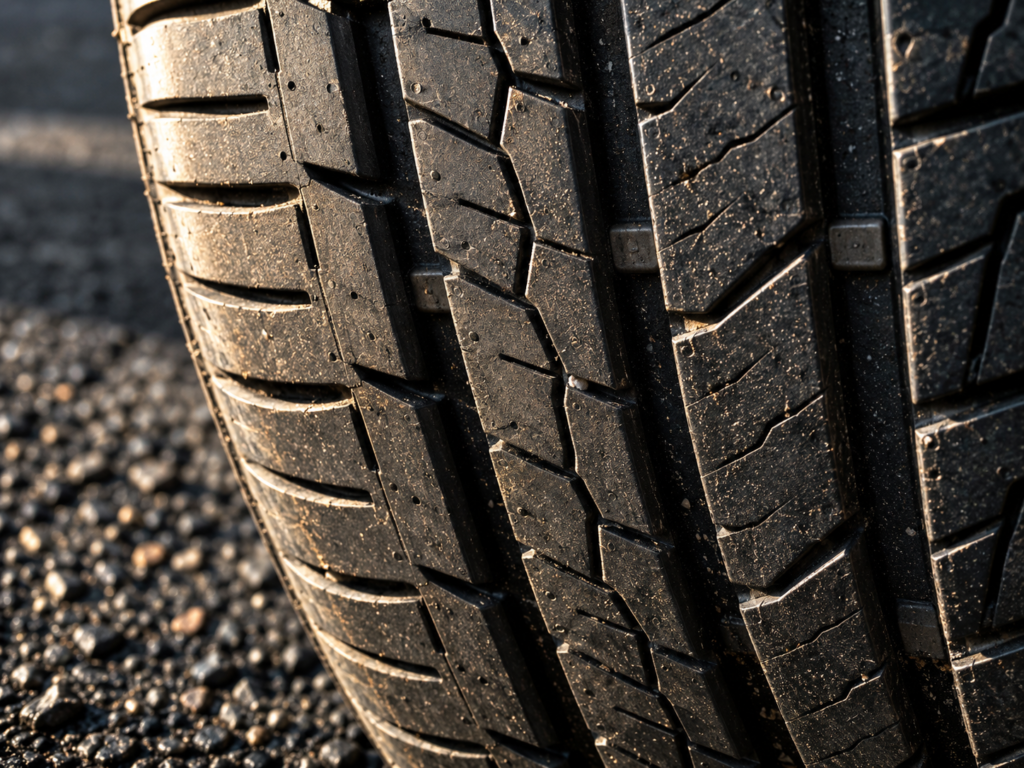
Tire tread pattern is the raised design on the tire surface that contacts the road, consisting of rubber blocks, grooves, and fine slits arranged in specific geometric patterns. This design is not random; every line and every angle in the tread has a precisely calculated function by tire engineers.
The basic functions of tire tread patterns include:
- Water evacuation from under the tire to reduce the risk of hydroplaning when driving in the rain.
- Providing grip with the road surface during acceleration, braking, and cornering.
- Reducing noise generated by the tire's friction with the asphalt, especially in symmetrical treads designed for comfort.
- Eliminating gravel, mud, and sand in specialized off-road treads, through wider and deeper grooves.
- Improving cornering stability by distributing tread blocks asymmetrically on both sides of the tire in some patterns.
Understanding the function of tire tread patterns in this way clarifies why there is no single "best" pattern absolutely; each pattern is designed to solve a specific problem or improve a specific performance, and the right choice depends on your actual needs as a driver.
Basic Elements of Tire Tread Patterns
Before diving into tread types, it is useful to know the basic components that repeat in every design:
- Tread Blocks: The raised rubber pieces that directly contact the road; their shape and arrangement determine the level of grip and stability.
- Grooves: The deep channels between the blocks, responsible for evacuating water, mud, and snow away from the contact surface.
- Sipes: Very fine lines inside the blocks themselves, increasing "gripping edges" on wet or icy surfaces.
- Ribs: Continuous lines extending around the tire circumference, improving stability in straight-line driving on highways.
These four elements combine in different arrangements to form the multiple tire tread patterns that we will explain in the next section.
Main Types of Tire Tread Patterns and the Function of Each
1. Symmetrical Tread
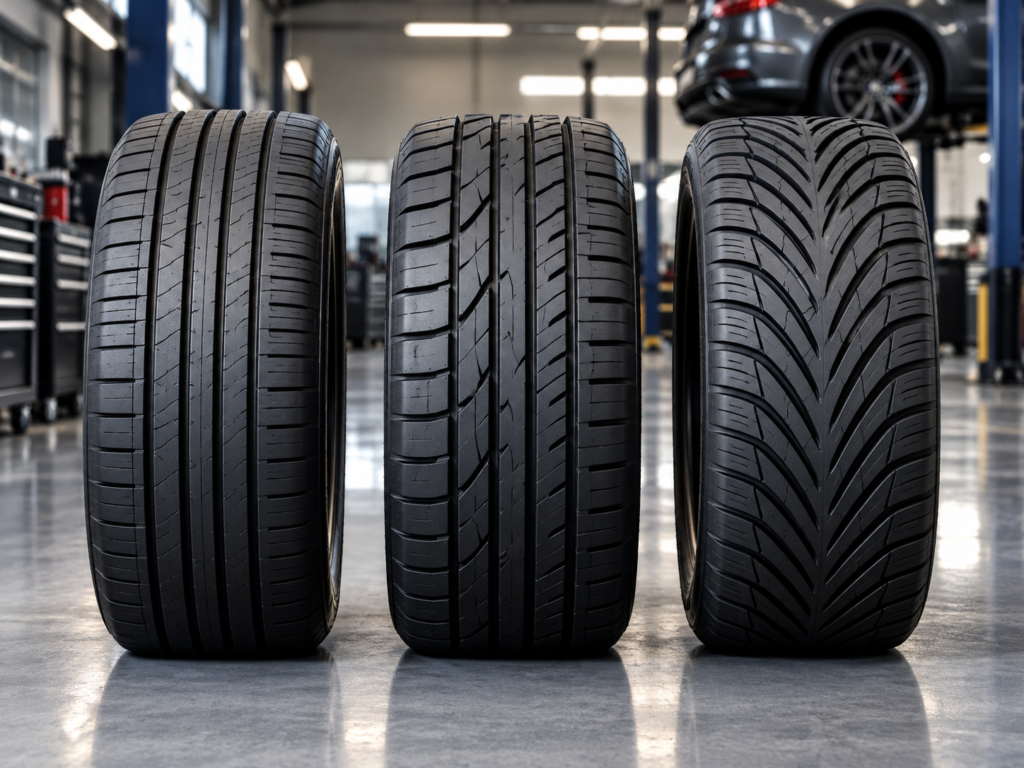
The most common pattern in daily car tires. The tread is identical on both the inner and outer sides of the tire, and is often built on continuous ribs or regularly repeating blocks across the entire width of the tire.
- Function: Providing a quiet and stable ride with good tread life and balanced wear distribution.
- Best for: Daily city driving, family cars, and those seeking comfort and economy more than sporty performance.
- Additional feature: Greater flexibility in rotation options among the four wheels, which extends the overall tire life.
2. Asymmetric Tread
Here, the tread design differs between the inner and outer sides of the tire itself; the outer side contains larger and stiffer blocks to improve cornering grip, while the inner side contains smaller blocks and more grooves to evacuate water efficiently.
- Function: Balancing stability in dry driving and control on wet roads, in a single tire.
- Best for: Modern sedans and mid-performance SUVs that need a balance between comfort and sporty control.
- Important point: This type is installed so that the "outer" side (usually marked "Outside" on the sidewall) always faces outward during installation.
3. Directional Tread
Characterized by V-shaped grooves all pointing in one direction toward the center of the tire, specifically designed to rotate in one specific direction only, indicated by an arrow on the sidewall.
- Function: Evacuating large amounts of water at high speeds, significantly reducing the risk of hydroplaning at high speeds or in heavy rain.
- Best for: Highways that experience seasonal rain, and high-performance cars.
- Important restriction: Rotation is limited to the same axle (front-to-back) only, and the tire cannot be swapped between the right and left sides without reversing the rotation direction.
4. Combined Tread (Asymmetric + Directional)
Combines the advantages of the previous two patterns: asymmetric blocks on the sides with directional grooves for water evacuation. This pattern is common in high-performance sports and luxury car tires.
- Function: The highest level of cornering grip with excellent water evacuation efficiency at the same time.
- Best for: Sports cars and high-performance vehicles that prioritize precise control over tire life economy.
- Rotation restriction: The most restricted among all patterns, and sometimes cannot be rotated at all if the front and rear tire sizes are different.
Specialized Tire Tread Patterns for Off-Road and Sand
Away from the three basic patterns, there is a very important category for Saudi drivers specifically: Off-road tires, which are divided into:
- All-Terrain: Medium-sized tread blocks with deeper grooves than standard tires, designed to navigate between paved roads and light dirt and sand roads without significantly sacrificing comfort on asphalt.
- Mud-Terrain: Huge and widely spaced tread blocks with wide grooves for self-cleaning of trapped sand and mud, making it the most suitable choice for SUVs dedicated to actual desert challenges, but it is noisier and less fuel-efficient on paved roads.
This classification directly answers the question of SUV tire tread patterns: If your car usage is limited to the city and highways, a standard asymmetric or directional tread is sufficient as needed. However, if you regularly go out to dunes or dirt roads in provinces like Al-Ula, Al-Ahsa, or the desert surroundings of Riyadh, investing in specialized off-road tires makes a real difference in safety and control.
Comprehensive Comparison Table of Tire Tread Patterns
| Pattern | Main Feature | Weakness | Best for |
|---|---|---|---|
| Symmetrical | Comfort, quietness, high rotation flexibility | Less grip in sharp corners compared to advanced patterns | Daily driving and family cars |
| Asymmetric | Balance between stability and wet control | Sensitive installation regarding inner/outer side direction | Modern sedans and mid-performance SUVs |
| Directional | Excellent water evacuation at high speeds | Rotation limited to the same axle only | Highways with seasonal rain |
| Combined (Asymmetric + Directional) | Highest grip in high performance | Higher cost and sometimes near-zero rotation | Sports and luxury cars |
| All-Terrain | Balance between asphalt and dirt roads | Slightly higher noise than standard tread | SUVs using mixed roads |
| Mud-Terrain | Strong performance in heavy sand and mud | High noise and higher fuel consumption on asphalt | Actual desert challenges and severe off-road |
How Do Tire Tread Patterns Affect Driving on Saudi Roads and Climate?
Tire tread patterns do not work in isolation from the environment; Saudi roads and climate impose special considerations worth noting:
- High temperatures: Extreme heat accelerates rubber hardening over time, gradually reducing tread flexibility; therefore, it is recommended to monitor tire tread depth more regularly in the summer.
- Sand and dust: Standard paved road treads may fill with fine sand on desert roads, reducing actual grip; here, the importance of off-road tires with deeper grooves capable of self-cleaning from sand appears.
- Seasonal rains: Although relatively rare, rains in areas like Jeddah, Asir, and Al-Baha are sometimes heavy and occur quickly on dry asphalt accumulated with oils, suddenly increasing the risk of hydroplaning; here, a summer tire tread with a directional or asymmetric design becomes a safer option than just the basic tread.
- Long highways: Long trips between cities need a tread that provides good stability in straight-line driving and withstands high asphalt heat for long periods without rapid performance degradation.
Guide to Choosing the Right Tire Tread Pattern for Your Car
Use these questions to determine the best tire tread pattern for your actual needs:
- What is your primary car usage? If it's just daily city driving, symmetrical tread is usually sufficient and more economical.
- Do you regularly go out to dirt or sandy roads? If the answer is yes, seriously consider an All-Terrain tread even if your car is a standard sedan occasionally used off-asphalt.
- Is your SUV dedicated to actual desert challenges? Then it's worth investing in specialized Mud-Terrain tires despite the extra noise on asphalt.
- Do you regularly drive on long highways? Directional or asymmetric tread provides better stability at high speeds compared to basic symmetrical tread.
- What is your budget? Advanced patterns (directional, combined, specialized off-road) are usually more expensive than standard symmetrical tread; balance the cost and actual benefit according to your driving style.
In general, there is no single best tire tread pattern that suits everyone; knowing the available types of tires and matching them to your actual usage is the right way to make a decision, instead of choosing the most famous or most expensive pattern only.
After determining the suitable pattern, you can browse the original tire collection available at KafaratPlus in various brands and sizes, or check specific brand guides like the Michelin Tires Guide in Saudi Arabia to compare available treads within each brand.
Tire Tread Depth: How to Check It and When to Change the Tire?
Tire tread depth is the most important practical indicator to determine if the tire is still safe to use:
| Tread Depth | Condition | Recommended Action |
|---|---|---|
| More than 4 mm | Good | Continue normal use with periodic checking |
| Between 2 and 4 mm | Noticeable decline | Monitor performance in rain and start planning for replacement |
| Less than 1.6 mm | Unsafe | Immediate replacement; the globally safe minimum limit |
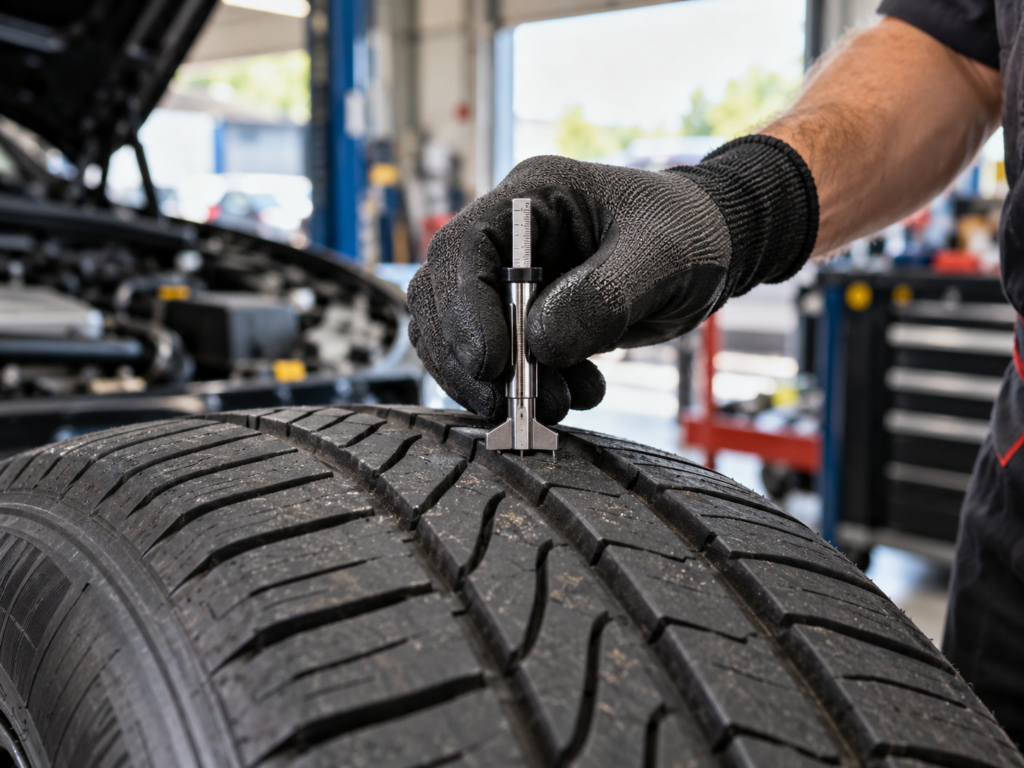
The coin test is a simple way to check tire tread at home: Insert a coin into the tread groove at several points around the tire; if a large part of the coin's engraving is clearly visible, this is an indicator that the tread is approaching the safe minimum limit and needs immediate professional inspection.
Tire Tread Depth: When is it Safe and When to Replace?
Abnormal Tire Tread Wear Patterns: What Do They Tell You About Your Car?
Not all worn tire tread patterns are the same; the way the tread actually wears reveals specific problems in the car before they turn into major breakdowns. Carefully monitoring the tire tread allows you to detect these signals early:
| Wear Shape | Most Likely Cause | Recommended Action |
|---|---|---|
| Wear concentrated in the middle of the tread | Air pressure higher than recommended | Correct air pressure immediately according to the door sticker or owner's manual |
| Wear on the tread edges only | Low air pressure | Inflate the tire to the correct pressure and check for any potential slow leak |
| Wear on one side of the tire only | Wheel alignment issue | Professional wheel alignment check and correction |
| Irregular wear in the form of scattered patches | Tire imbalance or suspension problem | Tire balancing check and suspension system inspection |
| Rapid and abnormal wear despite normal use | Low manufacturing quality or tread pattern unsuitable for driving nature | Review available types of tires and choose a more suitable pattern for your actual need |
Reading these patterns correctly saves you the cost of repeatedly replacing new tires, because most causes of abnormal wear are correctable with a simple check instead of enduring the same problem with every new set of tires.


Common Mistakes When Choosing or Maintaining Tire Tread Patterns
- Installing different tread patterns on the same axle, which negatively affects the car's balance and stability during braking and cornering.
- Ignoring the rotation direction in directional tires, which greatly reduces water evacuation efficiency even if the tread itself is in good condition.
- Choosing a standard tread for paved roads only despite frequent off-asphalt use, which accelerates tire damage and reduces actual grip on sand.
- Neglecting regular tire rotation, which leads to uneven wear that significantly shortens the tread life.
- Relying on external appearance only without checking the actual tread depth, even though a tire that looks fine externally may actually be below the safe limit.
Expert Tips
- Ask the technician to clarify the tread pattern when buying new tires, not just the size and brand, as this determines how suitable they are for your actual driving style.
- Check tread depth before any long desert trip even if the tire looks visually fine.
- Do not mix new and semi-worn tires on the same car, as this disrupts the performance balance between the axles.
- Consider the tread pattern when rebalancing tires, as some advanced patterns need more precise adjustment than standard tread.
- If you alternate between daily use and frequent desert outings, consider a second set of tires dedicated to off-road instead of forcing one tread pattern to perform two completely different tasks.
Tire Tread Maintenance: Rotation, Pressure, and Balancing
Tire rotation is one of the most important factors in extending tread life and maintaining its balanced performance:
| Procedure | Recommended Frequency | Benefit |
|---|---|---|
| Tire rotation (according to allowed pattern) | Every 8,000 – 10,000 km approximately | Distributes wear evenly among the four tires |
| Air pressure check | Monthly, and before any long trip | Maintains the correct tread contact shape with the road |
| Tire balancing check | When noticing steering wheel vibration | Prevents uneven wear that accelerates tread damage |
| Wheel alignment check | Annually or when noticing the car pulling to one side | Maintains tread straightness and extends its actual life |
Factors Affecting Tire Tread Lifespan and Cost
- Driving style: Sudden acceleration and braking accelerate tread wear more than calm, regular driving.
- Type of roads usually used: Sandy and off-road roads exhaust standard tread faster than paved roads.
- Heat and continuous sun exposure: Accelerates rubber hardening and reduces tread flexibility over time in Saudi Arabia's hot climate.
- Manufacturing quality and brand: Well-known brands usually use rubber compounds more resistant to wear, which is reflected in both price and lifespan.
- Periodic maintenance: Neglecting air pressure, balancing, and rotation shortens the life of any tread regardless of its original quality.
The Easiest Way to Check Your Tire Tread: Contact KafaratPlus
The easiest way to know the condition of the tread patterns in your car is to contact the nearest branch of KafaratPlus; technicians will inspect the four tires and determine the pattern, depth, and general condition on your behalf, without the need for any tools or prior technical experience on your part.
Instead of trying to determine your tire tread type or measure its depth yourself, it is enough to:
- Go to the nearest branch of KafaratPlus branches spread across Saudi Arabia.
- Request a comprehensive inspection of the four tire treads from a specialized technician.
- Get a clear and direct recommendation: Is the current tread suitable for your use, or does it need to be changed or a different pattern chosen.
This is the simplest way for any driver who does not want to delve into technical details themselves: Just contact KafaratPlus, and the team will handle all inspections on your behalf.
Conclusion
Understanding tire tread patterns, their types, and their different functions turns the decision to buy tires from a random guess into a thoughtful choice that suits your actual driving method and the Saudi roads you regularly take. Whether you are looking for a quiet symmetrical tread for daily use, a balanced asymmetric tread, a directional tread to face seasonal rains, or off-road tires for desert adventures, the correct knowledge of the function of each pattern is the basis of a safe and economical decision at the same time. And do not forget that checking tread depth regularly, monitoring its wear shape, and its periodic maintenance through rotation and air pressure adjustment are no less important than choosing the right pattern from the beginning — the best tire tread pattern in the world will not perform its function completely without continuous care throughout its lifespan.
Frequently Asked Questions
What are the types of tire tread patterns?
The main types are: symmetrical, asymmetric, directional, and combined (asymmetric + directional), in addition to specialized patterns for off-road such as All-Terrain and Mud-Terrain.
What is the function of tire tread patterns in general?
Water evacuation, providing grip with the road during driving, braking, and cornering, reducing noise, and eliminating gravel and sand in specialized off-road patterns.
What is the best tire tread pattern for daily use?
Symmetrical tread is usually the best choice for daily city driving, as it provides comfort, quietness, and rotation flexibility, unless you need additional improvement in rain, then asymmetric tread suits you.
What is the best tire tread pattern for SUVs in Saudi Arabia?
It depends on usage: if the SUV is mostly used on asphalt with light dirt road outings, an All-Terrain tread is suitable; but for repeated actual desert challenges, a Mud-Terrain tread is more suitable despite the extra noise.
How do I know the correct tire tread direction during installation?
Directional tires carry an arrow printed on the sidewall indicating the correct rotation direction; ensure the technician follows this direction during installation to ensure full water evacuation efficiency.
What is the safe tire tread depth?
The tread depth should not be less than 1.6 mm as a safe minimum limit; experts recommend starting to plan for tire replacement when reaching 2–3 mm to anticipate gradual performance decline, especially in rain.
Can different tread patterns be mixed on the same car?
This is absolutely not recommended, especially on the same axle, because different tread patterns affect the grip balance between the four tires and weaken the car's stability during braking and cornering.
What is the difference between summer tire tread and winter tire tread?
Summer tread is designed with a rubber compound and grooves suitable for high temperatures and seasonal rain water evacuation, while winter tire tread contains dense fine slits and a rubber compound that is softer in the cold to improve grip on ice and snow — which is practically less important in most areas of Saudi Arabia except for some mountainous heights.
When should tires be rotated?
Usually every 8,000 to 10,000 kilometers approximately, taking into account that some directional or combined patterns allow limited rotation on the same axle only and not between the sides.
Does tire tread pattern affect fuel consumption?
Yes, tread with large blocks and deep grooves (like Mud-Terrain) increases rolling resistance and thus fuel consumption compared to the standard symmetrical tread designed for efficiency on asphalt.